

An airport is generally somewhere people try to escape. At JFK's TWA Hotel, the whole idea is to stay. Behind the sweeping concrete curves of a former airline terminal lies a peculiar monument to an era when flying was glamorous, smoking was practically a competitive sport, and passengers actually dressed for the occasion.
There are few places on Earth where people are as universally determined to leave as an airport.
John F. Kennedy International Airport is certainly no exception.
It's a sprawling monument to modern aviation, where thousands of travelers spend their days navigating security checkpoints, overpriced sandwiches, delayed departures, and the occasional existential crisis at a boarding gate.
Nobody particularly wants to spend more time at JFK than necessary.
Which makes voluntarily booking a 24-hour stay inside the airport a somewhat questionable decision.
But tucked away among the terminals, taxiways, and relentless machinery of international air travel is something entirely unexpected.
A relic of an America that once believed flying should be an occasion.
The TWA Hotel.
And for one winter stay, the accommodation wasn't a conventional airport room. It was the Howard Hughes Suite, named after one of the most fascinating, eccentric, and occasionally troublesome figures in American aviation history.
When Flying Was an Occasion
Long before commercial aviation became an exercise in maximizing overhead-bin space, airlines were selling something considerably more romantic.
The future.
Flying was glamorous. Aircraft were technological marvels. Airlines competed not merely on schedules and destinations, but on the promise of an entirely new way to experience the world.
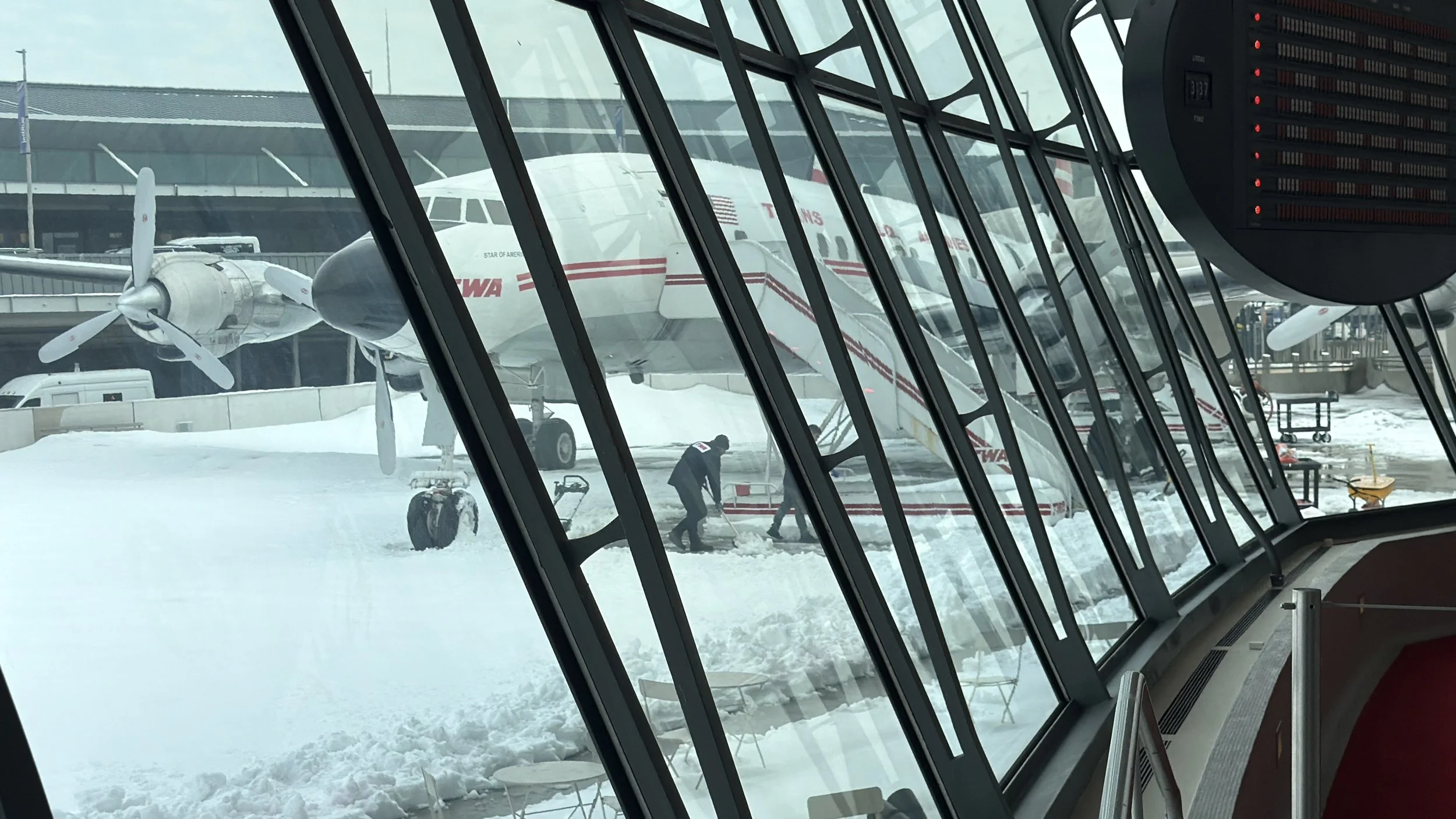
Trans World Airlines, better known as TWA, was among the great names of that era.
And at JFK, it had a terminal to match its ambitions.
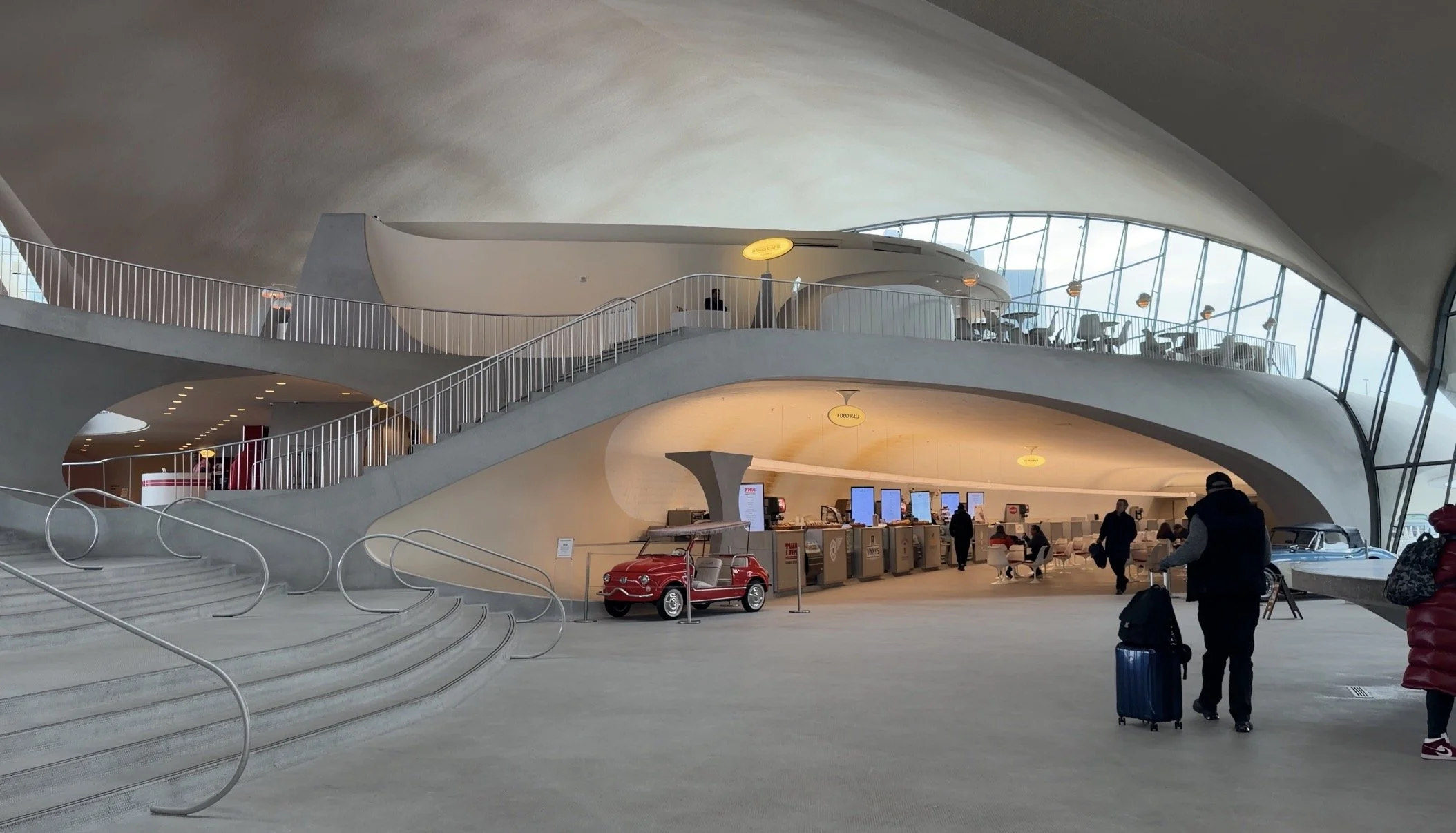
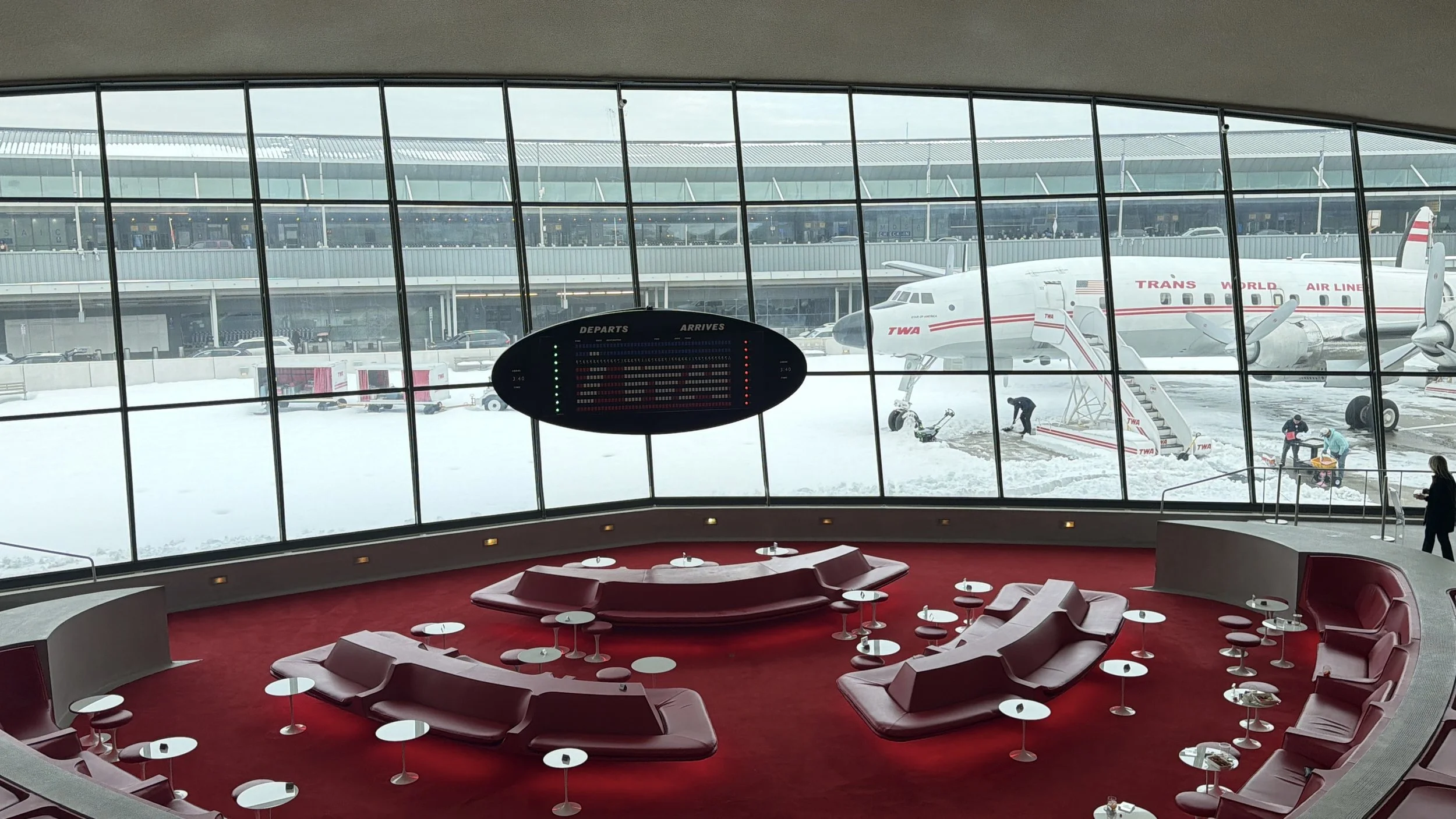
Designed by Finnish-American architect Eero Saarinen and opened in 1962, the TWA Flight Center was unlike practically anything else at the airport.
Its sweeping concrete roof appeared to be suspended in motion, like an enormous bird preparing to take flight.
Inside, traditional architectural boundaries seemed almost irrelevant. Walls curved into ceilings, corridors flowed into open spaces, and the entire structure seemed determined to reject the idea that an airport terminal should resemble an office building with airplanes parked outside.
It was ambitious, futuristic, and unmistakably American.
It was also a product of a very different aviation industry.
The terminal eventually became obsolete as commercial aviation evolved, particularly with the introduction of larger aircraft and changing airport requirements. TWA itself disappeared into American Airlines in 2001.
For years, the building's future remained uncertain.
Fortunately, it survived.
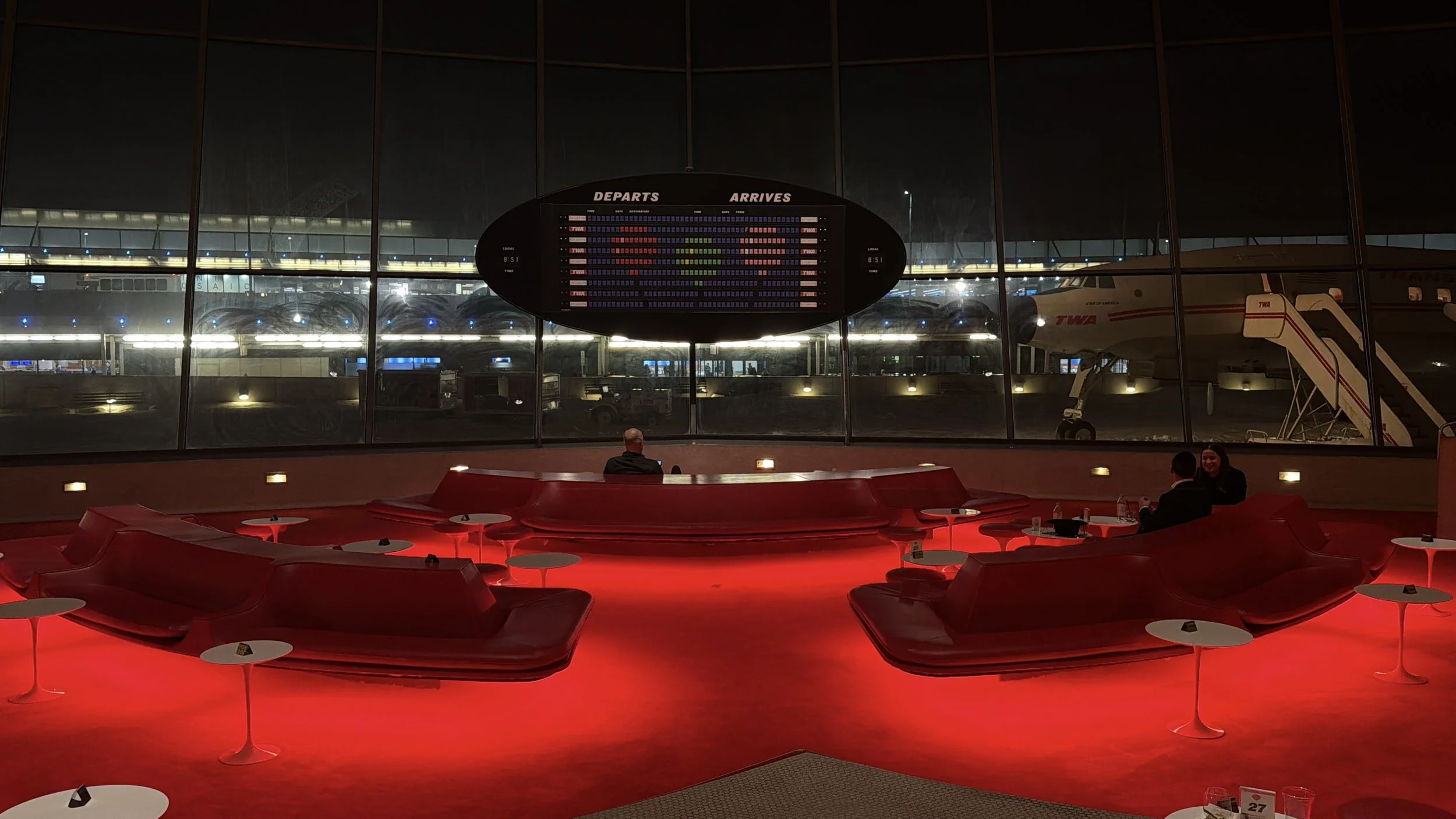
Today, the restored terminal serves as the centerpiece of the TWA Hotel, which opened in 2019. Two modern hotel wings provide the accommodations, while Saarinen's original building houses much of the property's public space.
The result is an unusual arrangement.
A functioning hotel built around a historic airport terminal, celebrating an airline that no longer exists.
In New York, where perfectly serviceable buildings are routinely demolished to make way for considerably less interesting ones, its survival feels like a minor miracle.
The Man Behind the Suite
Howard Hughes was not exactly an ordinary businessman.
He was a filmmaker, industrialist, record-setting aviator, and one of the wealthiest men in America. He was also famously reclusive, notoriously difficult, and possessed of the sort of eccentricities that would make even the most patient hotel concierge reconsider their career choices.
But Hughes understood aviation.
During the 1930s, he acquired a controlling interest in TWA and helped push the airline toward more advanced aircraft and ambitious long-distance routes.
He was deeply involved in the development and adoption of the Lockheed Constellation, an aircraft whose distinctive triple-tail design became one of the great symbols of the propeller-driven airline era.
For Hughes, aviation was more than transportation. It was a technological obsession and an enormous business undertaking.
His relationship with TWA was far from uncomplicated. Financial disputes, regulatory battles, and his own increasingly unpredictable behavior eventually complicated his control of the airline.
Nevertheless, his influence remains inseparable from its history.
Naming a suite after Hughes inside the former TWA terminal is therefore entirely appropriate.
There is also a certain irony to it.
A man who became increasingly obsessed with isolation and privacy now lends his name to a hotel suite at one of the busiest international airports in the world.
One suspects he might have appreciated the privacy.
The airport traffic, perhaps less so.
Checking In Without Checking Out
Most airport hotels exist for a fairly straightforward purpose.
You arrive late, sleep for a few hours, take a shower, and leave early enough to avoid missing your flight.
Nobody books an airport hotel expecting a cultural experience.
The TWA Hotel operates on a different premise.
Here, the airport is not merely an inconvenient neighbor. It is the attraction.
Spending 24 hours at the property provides an opportunity to experience the former terminal without the usual pressure of a departure time.
There is no immediate need to hurry toward a gate, locate a boarding pass, or wonder whether the security line is going to consume the next hour of your life.
Instead, the terminal becomes a destination to explore.
The architecture is the obvious centerpiece.
Saarinen's extraordinary design feels like a physical manifestation of the Jet Age, a period when American optimism was expressed through dramatic architecture, ambitious engineering, and the belief that tomorrow would inevitably be more exciting than today.
It is difficult to imagine a modern airline commissioning something quite like it.
Today's terminals tend to prioritize passenger throughput, retail space, operational efficiency, and the logistical challenge of moving enormous numbers of people through increasingly complicated systems.
Those priorities are understandable.
But they rarely produce buildings that people travel specifically to admire.
The TWA Flight Center is different.
It was designed to make a statement.
More than six decades later, it still does.
Spending the Night With Howard Hughes
There are hotel rooms with ocean views, mountain views, city views, and occasionally a spectacular view of the neighboring parking garage.
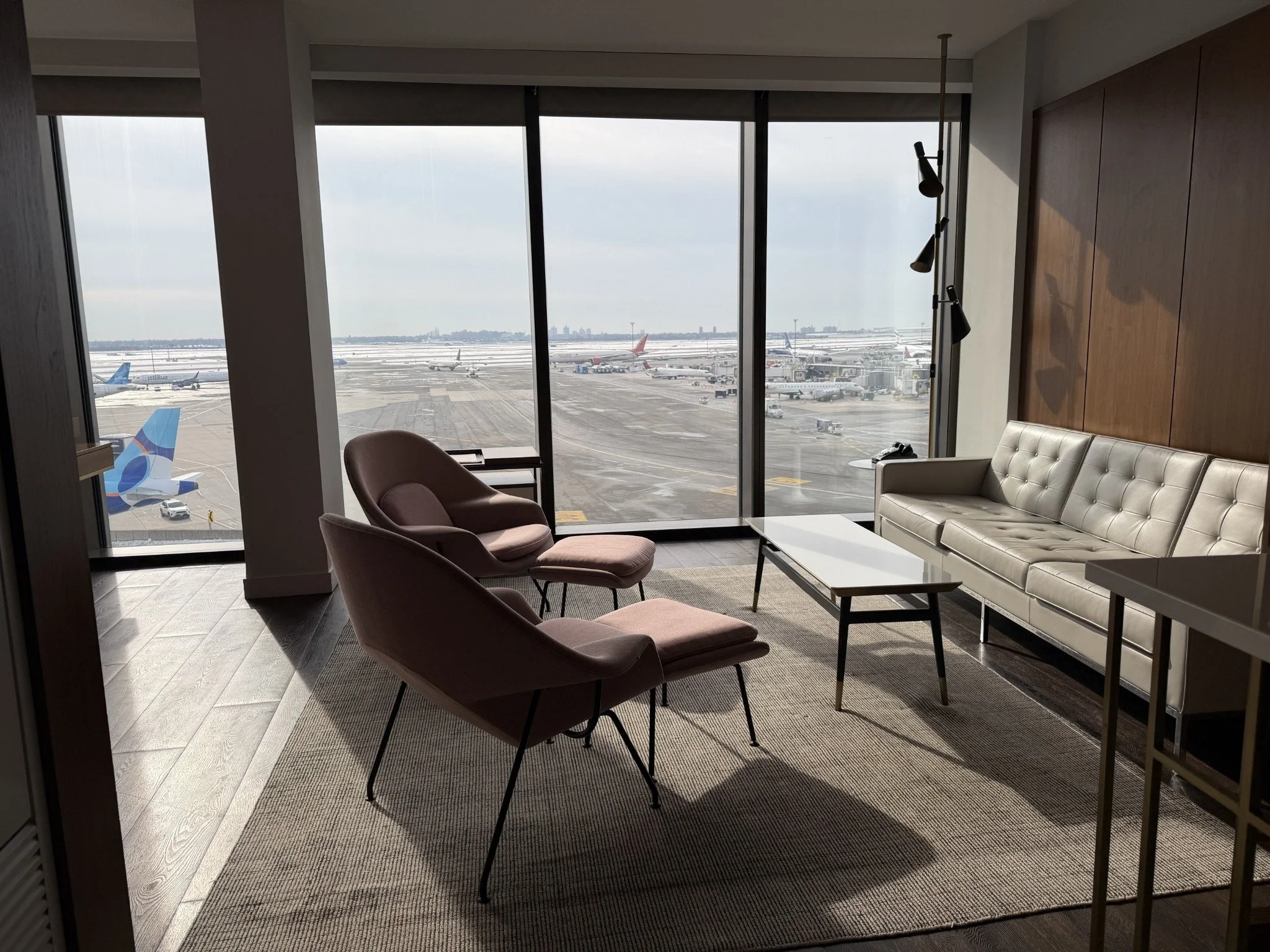
Then there's the Howard Hughes Suite.
From the windows, JFK's sprawling airfield becomes an enormous, constantly moving spectacle. Aircraft taxi toward departure, others descend toward the runways, and still more climb into the sky carrying passengers to destinations around the world.
The suite offered sweeping views of the airport's operations, including a clear look toward the A gates of Terminal 4 and a collection of JetBlue aircraft parked at their gates at Terminal 5.
Perhaps the most impressive part wasn't the view itself, but the complete absence of noise. Despite overlooking one of the busiest international airports in the country, the suite's soundproofing was exceptional. Aircraft taxied past the windows without so much as a whisper. It was like watching the world's most expensive silent film, with JFK providing the cast and absolutely nobody responsible for the soundtrack.
For anyone with even a passing interest in aviation, it is difficult to imagine a more entertaining view from a hotel room.
There is something strangely hypnotic about watching an international airport operate.
It's a carefully choreographed operation that most passengers barely notice.
Usually, the closest a traveler gets to observing any of this is through a terminal window while waiting for a boarding announcement.
Here, it happens outside the bedroom.
During the stay, a perfectly ordinary trip to the shower ended with a rather extraordinary encounter.
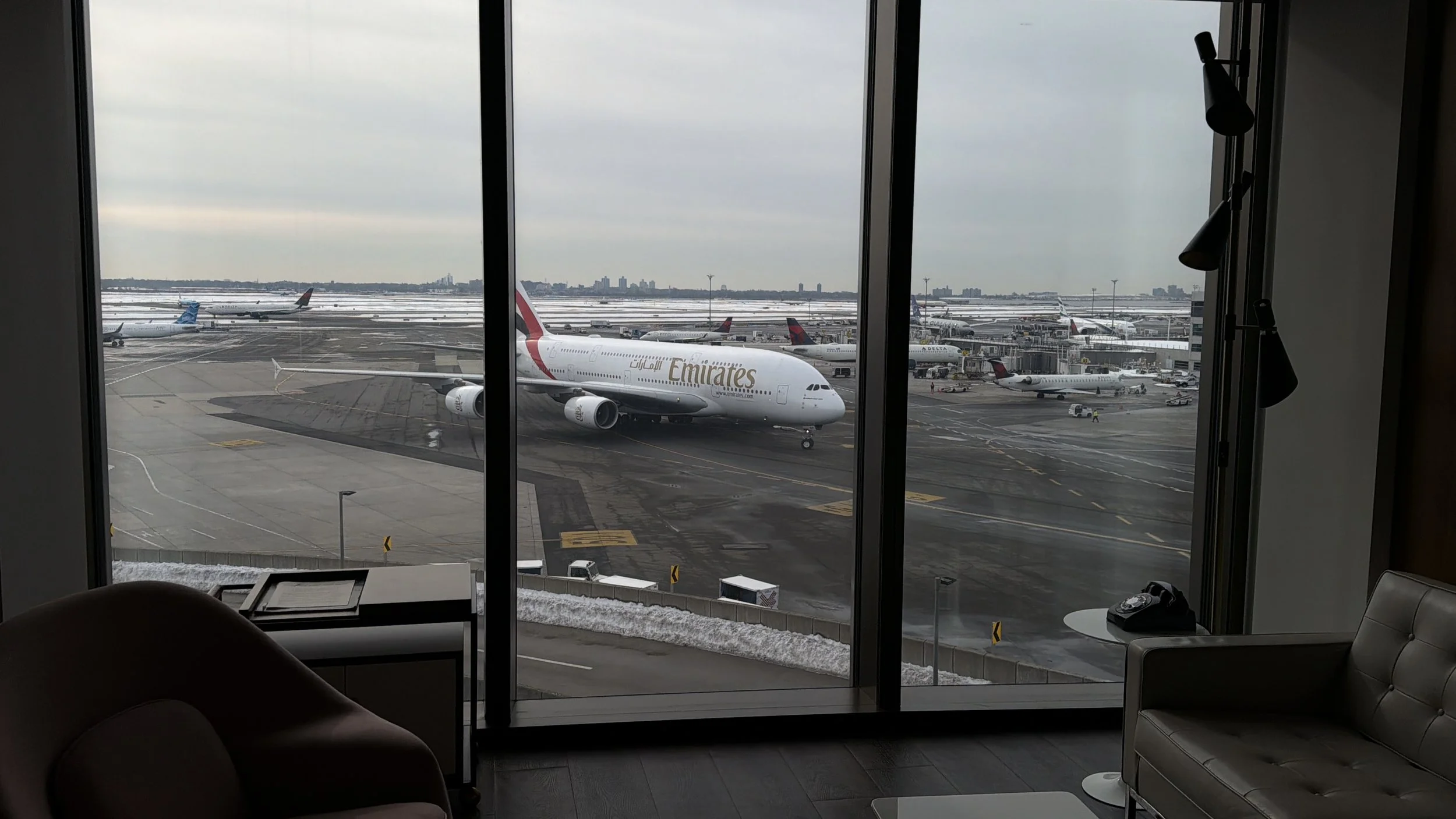
Emerging from the bathroom, I found myself face-to-face with an enormous Emirates Airbus A380 casually rolling past the windows.
The A380 is the world's largest passenger aircraft, a double-decked machine capable of carrying hundreds of people across continents.
It is not a particularly subtle piece of engineering.
And yet there it was, moving through JFK as though appearing outside someone's hotel room was the most natural thing in the world.
Most hotels offer a view of the sunrise or the ocean.
This one offers the possibility of being greeted by a four-engine, double-decked Emirates superjumbo before you've even finished getting dressed.
For an aviation enthusiast, it's difficult to complain.
The extraordinary thing about the suite isn't simply that aircraft can be seen from the windows. It's that the airport becomes part of the accommodation itself.
A quiet moment overlooking parked aircraft can suddenly become an impromptu airshow. A distant jet begins its takeoff roll. Another approaches for landing. Ground vehicles weave between the terminals as aircraft from airlines around the world come and go.
The room offers a front-row seat to one of the world's great international aviation hubs, without requiring a boarding pass.
Of course, an extraordinary view is only one part of a hotel stay.
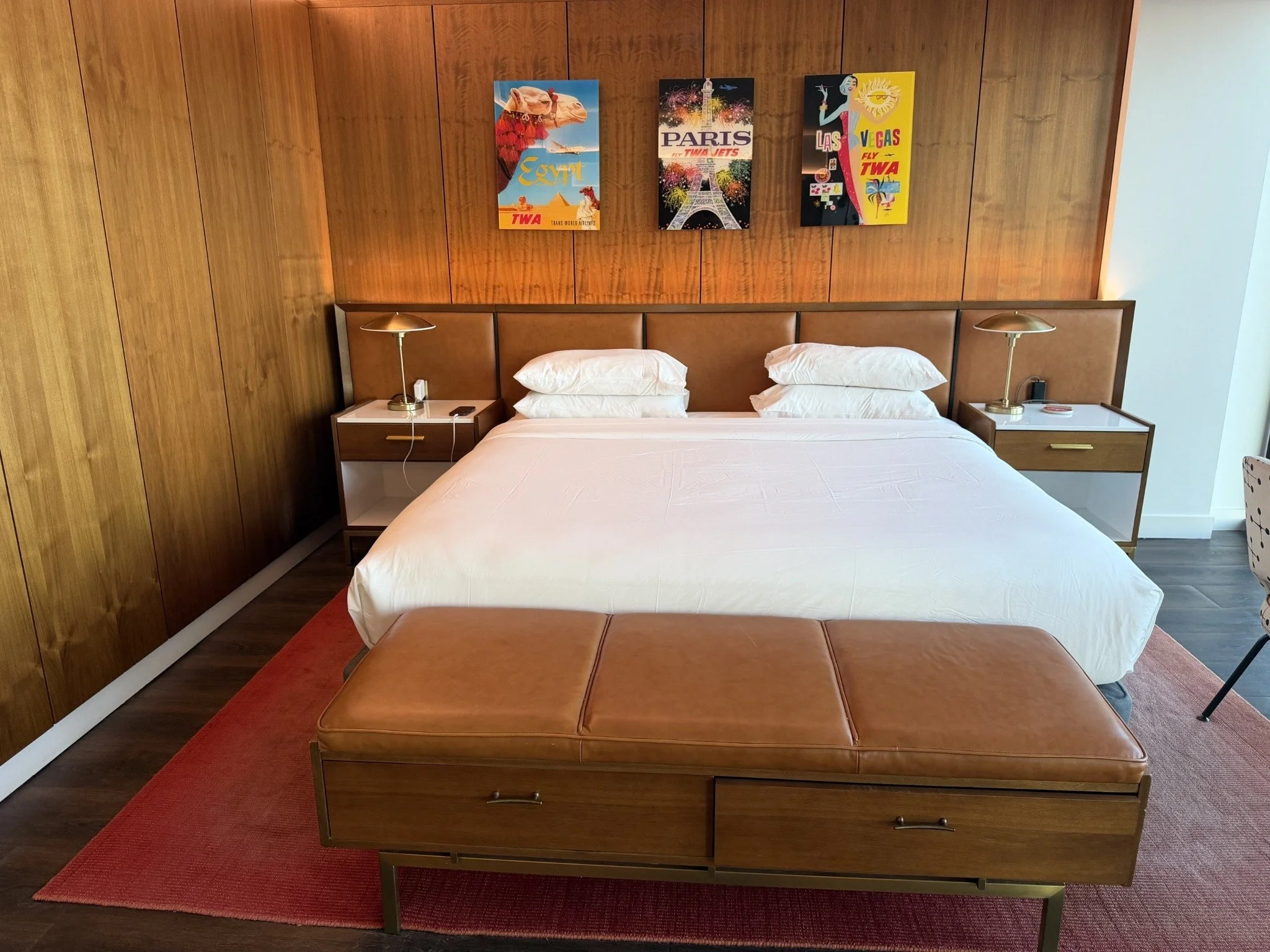
The fundamentals still matter: comfort, cleanliness, functionality, service, and value.
A famous name on the door cannot compensate for a disappointing room, and a remarkable airport panorama does not automatically justify whatever premium a hotel might charge.
But the Howard Hughes Suite has something that cannot easily be replicated elsewhere.
An uninterrupted connection to the very industry that inspired the property.
Howard Hughes spent much of his life obsessed with aircraft and aviation.
Decades later, guests staying in a suite bearing his name can watch the modern descendants of that industry operate just beyond the glass.
A Destination Without a Departure
Twenty-four hours at JFK is not an experience most travelers would voluntarily put on their itinerary.
Under ordinary circumstances, it sounds like a punishment imposed by an exceptionally cruel airline scheduling department.
But the TWA Hotel occupies an unusual position in American hospitality.
Here, proximity to the runway isn’t simply a practical convenience. It’s part of the attraction.
Beyond the historic terminal, the nostalgic furnishings, and the ghosts of aviation's golden age, there is the unmistakable spectacle of a working international airport.
Terminal 4. Terminal 5. Aircraft arriving, departing, and occasionally appearing outside the window at wonderfully inconvenient moments.
All of it unfolding in near-perfect silence, thanks to soundproofing that somehow manages to keep the chaos of JFK exactly where it belongs.
For aviation enthusiasts, it's paradise. For everyone else, it's a reminder that even the most ordinary parts of modern travel can become extraordinary when viewed from a different perspective.
The TWA Hotel has accomplished something remarkable.
It has made spending an entire day at JFK sound like a perfectly reasonable idea.
And considering the airport's usual reputation, that might be the most impressive achievement of all.
Is the TWA Hotel's Howard Hughes Suite Worth It?
For aviation enthusiasts, the Howard Hughes Suite offers something few hotels can replicate: a front-row seat to JFK's airfield, with views toward Terminal 4 and Terminal 5 and aircraft constantly moving beyond the windows.
The most surprising feature, however, is the soundproofing. Despite the enormous aircraft taxiing nearby, the room remained remarkably quiet.
Whether the suite represents good value depends on the nightly rate and what a guest expects from an airport hotel. But for travelers who consider watching an Emirates A380 roll past their window part of the entertainment, the experience offers something far beyond an ordinary overnight stay.